
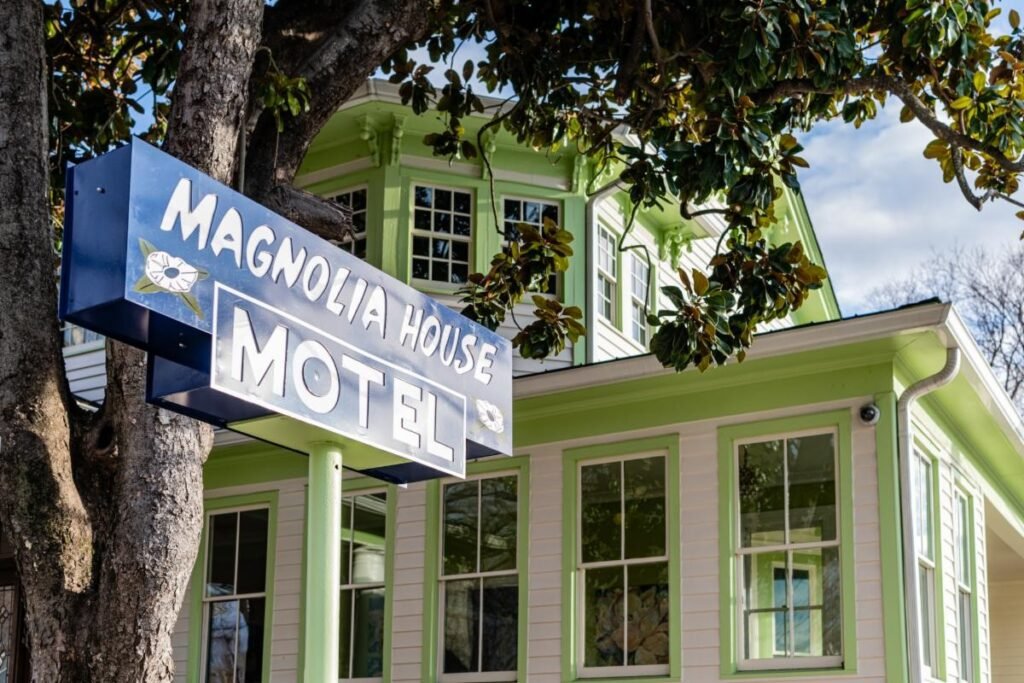
GREENSBORO – North Carolina becomes the second state in the nation with a Green Book Multiple Property Designation; Magnolia House becomes North Carolina’s first nationally recognized Green Book resource.
The Historic Magnolia House Foundation and preservation partners across North Carolina are celebrating a landmark victory in the preservation of Black American history.
The National Park Service has officially approved both the North Carolina Green Book Resource Multiple Property Documentation Form (MPDF) and the nomination of The Historic Magnolia House to the National Register of Historic Places as a Green Book Resource.
The approvals were issued by the Chief of the National Register of Historic Places/National Historic Landmarks Program and the Deputy Keeper of the National Register of Historic Places in Washington, D.C., marking a historic milestone for North Carolina and for the preservation of Black American travel history nationwide.
With these approvals:
• North Carolina becomes only the second state in the nation to receive a Green Book Multiple Property Designation.
• The Historic Magnolia House becomes the first site in North Carolina officially listed on the National Register of Historic Places for its significance as a Green Book Resource.
• A pathway is now established for North Carolina’s 327 documented Green Book sites to pursue National Register recognition under the newly approved statewide framework.
“This is more than a preservation achievement, it is a recognition of the people, places, and communities that created safety, dignity and opportunity during one of the most challenging periods in American history,” said Natalie Miller, CEO of The Historic Magnolia House.
For decades, Magnolia House served as a safe haven for Black travelers navigating segregation-era America. Listed in six editions of Victor H. Green’s “The Negro Travelers’ Green Book” (1955–1957 and 1959–1961), Magnolia House welcomed many of the most influential figures of the twentieth century, including Carter G. Woodson, Miles Davis, Louis Armstrong, Ray Charles, Lena Horne, Jackie Robinson, James Baldwin, and countless others.
The designation arrives at a particularly meaningful moment in American history.
In 2026, the nation commemorates the 100th Anniversary of Black History Month, founded by Dr. Carter G. Woodson, who stayed at Magnolia House during his travels. The year also marks the 90th Anniversary of Victor H. Green’s “Negro Travelers’ Guide,” commonly known as “The Green Book,” which documented safe lodging, restaurants and businesses for African American travelers during segregation.
As America celebrates its 250th anniversary, it is especially important to recognize the sites and stories that have historically been underrepresented in our national narrative.
The approval also addresses a longstanding gap in historic recognition. Today, only approximately 4% of the more than 90,000 listings on the National Register of Historic Places are recognized primarily for their contributions to African American history.
“This achievement is about increasing visibility for stories that have too often been overlooked,” said Miller. “We are proud that Magnolia House is helping grow that number, not only for North Carolina, but for communities across the country working to preserve Black history.”
The Historic Magnolia House’s successful nomination was the result of years of research, documentation, restoration, and advocacy led by preservation professionals, historians, community partners, and supporters who recognized the significance of preserving Green Book history.
The organization extends its deepest gratitude to the North Carolina State Historic Preservation Office (SHPO), the National Register Advisory Committee (NRAC), the National Park Service, the City of Greensboro Mayor and City Council, Richard Grubb & Associates, preservation consultant Sara Woodard, and the many community partners and supporters who helped make this achievement possible.
“This recognition affirms what our community has always known,” Miller added. “Magnolia House is not simply a historic building. It is a living testament to resilience, hospitality, entrepreneurship, and the power of safe spaces. Today, that legacy has been recognized at the highest level.”
As North Carolina becomes a national leader in Green Book preservation, Magnolia House Foundation and its partners (DNCR, National Trust for Historic Preservation, NC African American Heritage Commission, Visit NC, and others are already looking ahead to broader efforts, including Project 327: NC Green Book Trail Marker and Recognition Program, a statewide initiative dedicated to documenting, recognizing, and elevating North Carolina’s documented Green Book sites, truly connecting the cities of North Carolina through civil rights and the history of the Negro Traveler.
From safe haven to national recognition.
From overlooked history to federal acknowledgment.
From preservation to permanent legacy.
For more information, please visit www.thehistoricmagnoliahouse.org.